

Freemium vs Free Trial Decision Framework for SaaS Companies
A Practical Guide to Choosing the Right Free Experience for Your Subscription Product.

One of the most common strategic questions for SaaS companies is whether to offer a free trial or a freemium model. It’s a decision that can significantly impact acquisition, conversion rates, and overall revenue. Yet, many decisions on this are made based on instinct or imitation (following the approach of the market leader or similar companies) rather than a structured framework.
In this article I break down the decision-making process, exploring the key differences, benefits, and pitfalls of both models. My objective is to leave your with a clear framework to decide which approach works best for your business.
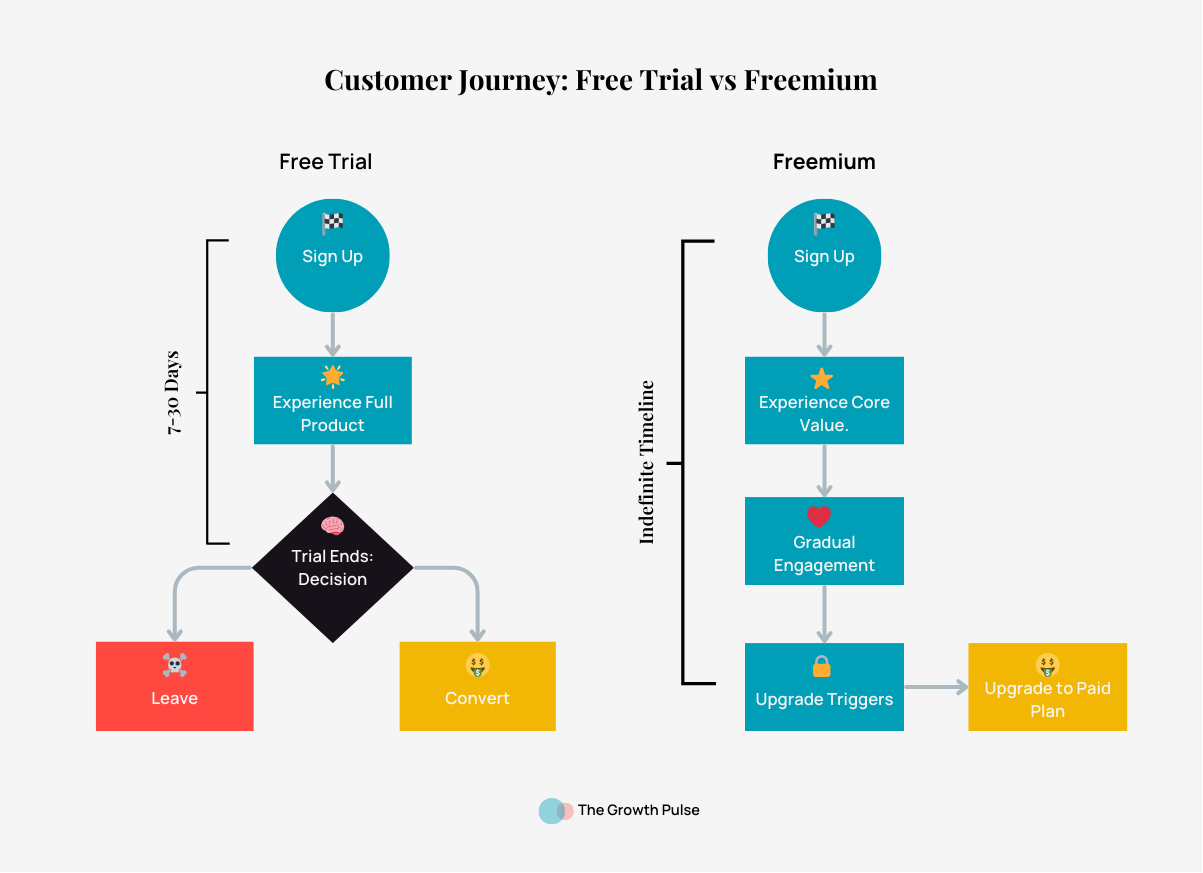
Free Trial vs. Freemium: Understanding the Difference
Both free trials and freemium models help potential customers evaluate your product, but the key distinction lies in time limitations and feature access:
Free Trial: Offers full or partial access to the product for a limited time → the goal is to get the user to unlock the core value of the product as quickly as possible and as many times as possible before the trial ends.
Freemium: Offers limited access to the product indefinitely → the goal is to get the user to build a habit and unlock the need for more advanced functionality.
A well-designed free trial allows users to experience the product’s full value within a set period, creating urgency to convert. A freemium model, on the other hand, aims to drive long-term engagement and upsell premium features over time.
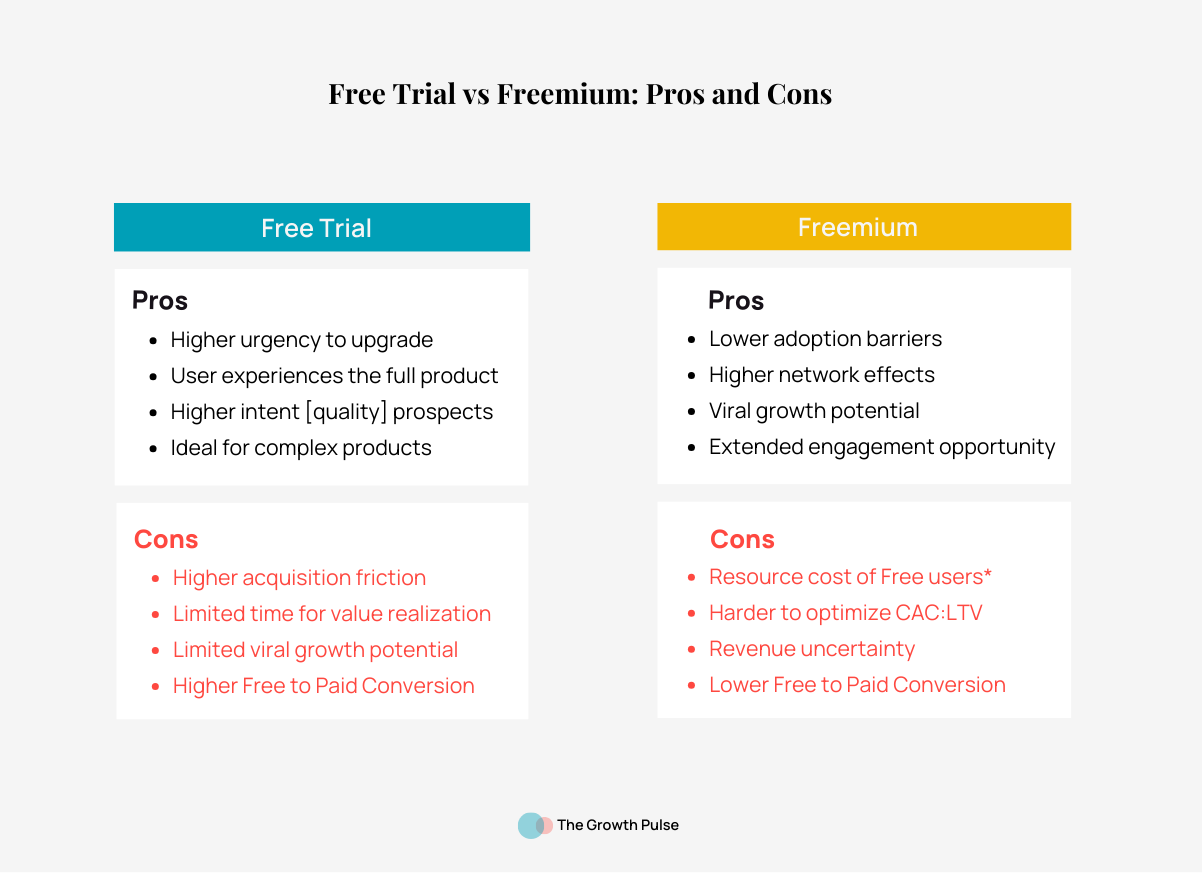
When to Choose a Free Trial
A free trial is often the better choice if:
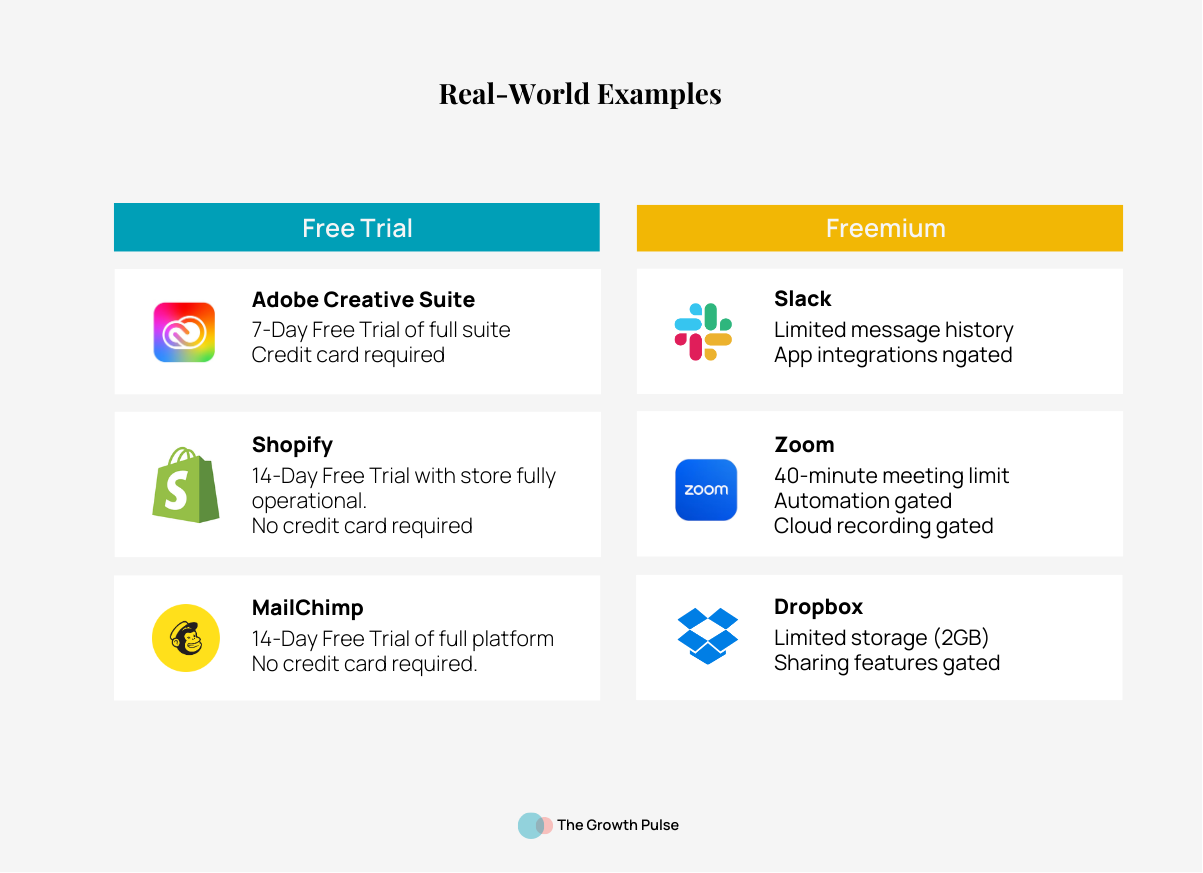
Your product has a fast time-to-value – If users can quickly experience the core benefits and their switching cost increases as they use the product, a free trial works well. Examples: Dropbox, Shopify, MailChimp.
Your onboarding process requires minimal hand-holding – If your product requires heavy implementation or setup, a short free trial might not be enough for users to reach an ‘aha’ moment.
Your product’s value scales with usage – If more usage unlocks more value, a trial provides just enough exposure to drive an upgrade.
Key Free Trial Considerations
Opt-in vs. Opt-out:
Opt-in Free Trial (No Credit Card Required): Low friction, more signups, higher trust factor, but lower conversion rates.
Opt-out Free Trial (Credit Card Required): Higher conversion rates but more friction, potential refund requests, and trust issues.
Ideal for: B2B SaaS with mid-to-high pricing and a clear ‘aha’ moment in days or weeks.
When to Choose Freemium
A freemium model is ideal if:
You have a large addressable market – If your TAM is massive (e.g., millions of potential users), freemium can drive viral adoption. Examples: Zoom, Notion, Canva, Figma.
Low cost per user – Your product should have minimal incremental costs per free user.
Clear upgrade levers – Users should naturally reach a point where they want or need to upgrade (e.g., storage limits, premium features).
Your product benefits from network effects – If more users lead to more value (e.g., collaboration tools like Slack, Dropbox, or AI applications like ChatGPT or Claude), freemium makes sense.
Key Freemium Considerations
Feature Gating vs. Usage Limits:
Feature-gating (e.g., Notion, Canva): Free users get access to core functionality - the core value of the product is always available to them, but need to upgrade for premium features and more robust workflows.
Usage limits (e.g., Zoom, Miro): Free users can only use a limited number of features (e.g., 40-minute meetings for free users, 3 editable boards).
Note: The free plan must be good enough for users to understand and experience the core value of the product, but not sufficient to unlock it’s full potential. This is a delicate dance, if the Free plan is too generous, users won’t feel the need to upgrade to a paid plan.
The Decision Framework
Use this matrix to determine the best fit for your SaaS business:
Factor Free Trial Freemium Time-to-Value Fast Slower Market Size Medium-Large Large Product Complexity Medium Low Onboarding Required Minimal Self-serve Acquisition Strategy Sales + PLG PLG Monetization Focus Conversion Expansion
How Your Growth Strategy Impacts the Decision
Your SaaS company’s growth strategy plays a crucial role in choosing between a free trial and a freemium model. Let’s break it down:
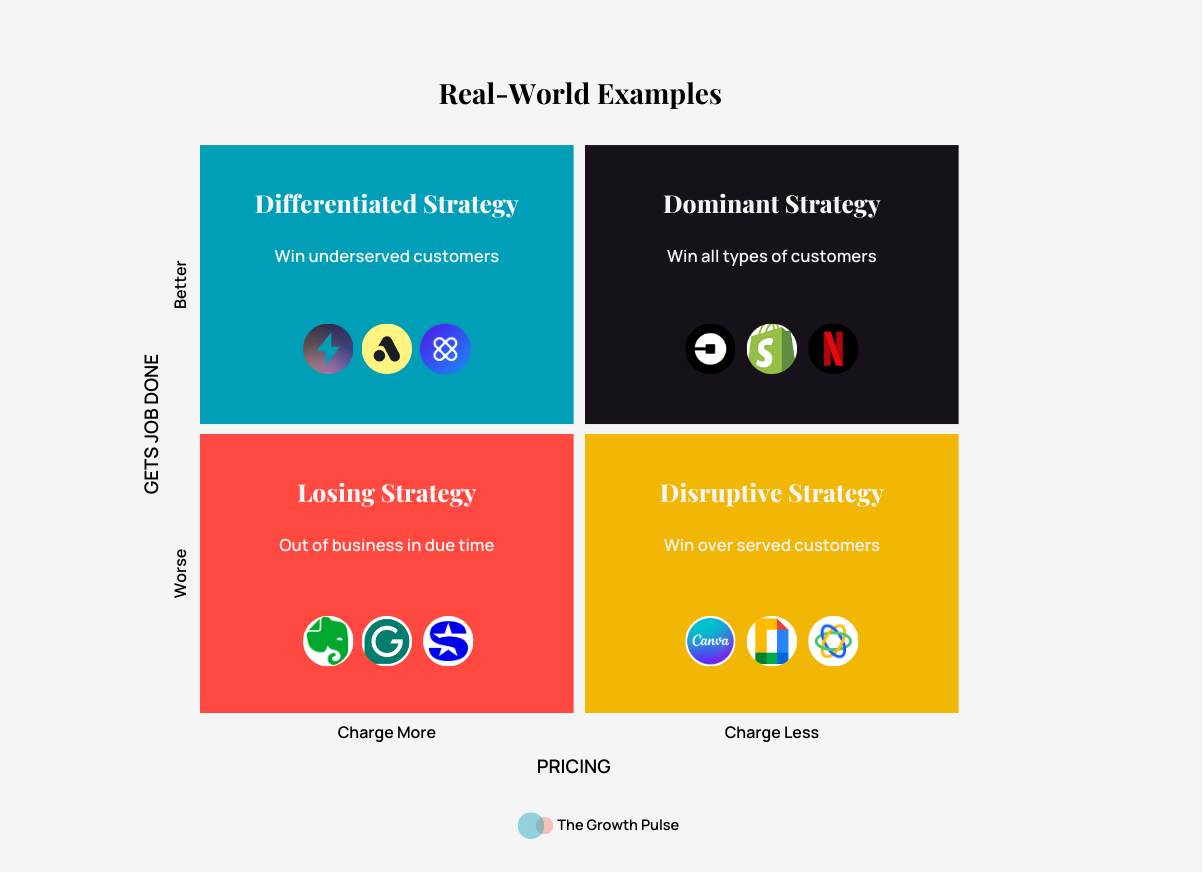
Dominant Growth Strategy
If your SaaS product is significantly better than competitors and priced lower, a dominant strategy applies. Examples: Netflix, Uber, Shopify.
Freemium is a strong choice as it allows rapid adoption and market capture.
Free trials can also work if your product provides immediate value.
Key question: Is your market big enough to support a freemium model?
Differentiated Growth Strategy
A differentiated strategy works when your product solves a niche problem better than competitors and is priced higher. Example: Attentive (ai agents for sales teams), Affinity (CRM for investment banking), Attentive (SMS marketing).
Free trials are preferred since prospects need time to evaluate the product.
Freemium is risky because niche audiences may not upgrade if they get enough value for free.
Key question: Can users experience an ‘aha moment’ in a free trial?
Disruptive Growth Strategy
If you’re offering a simpler, lower-cost alternative to an established product, you’re using a disruptive strategy. Examples: Canva vs. Photoshop, Google Docs vs. Microsoft Office.
Freemium thrives here because users can try a simpler solution risk-free.
Free trials can work but might limit the “magnetic draw” of switching from a complex competitor.
Key question: Is your market full of over-served customers looking for a simple alternative?
Can You Combine Both?
Yes! Many companies successfully blend freemium + free trial + sales assist:
Freemium with a Free Trial on Premium Features – Users start on a free plan but can try premium features for a limited time. Example: HubSpot.
Free Trial First, Then Freemium – If users don’t convert after a trial, offer a limited free version to keep them engaged. Example: Canva.
However, to successfully implement a hybrid approach, companies need to understand the psychological differences between Freemium (free forever) and Free Trials (time-limited). It’s not enough to offer both models—you must have a clear path to conversion for users in each.
Where most companies fall short with Freemium is the same place they fall short elsewhere: they fail to map out how to move users toward becoming paying customers once they’ve captured attention. Whether it takes 14 days in a Free Trial or six months as a Freemium user, you need a strategy to actively guide them toward conversion.
If your Free Trial downgrades to a Freemium version upon expiration—a common hybrid model—you must also have a plan to reactivate these users. How will you nudge them toward upgrading? If they never convert, can they still provide value by referring new users or promoting your product? If not, are you wasting resources on free users with no return?
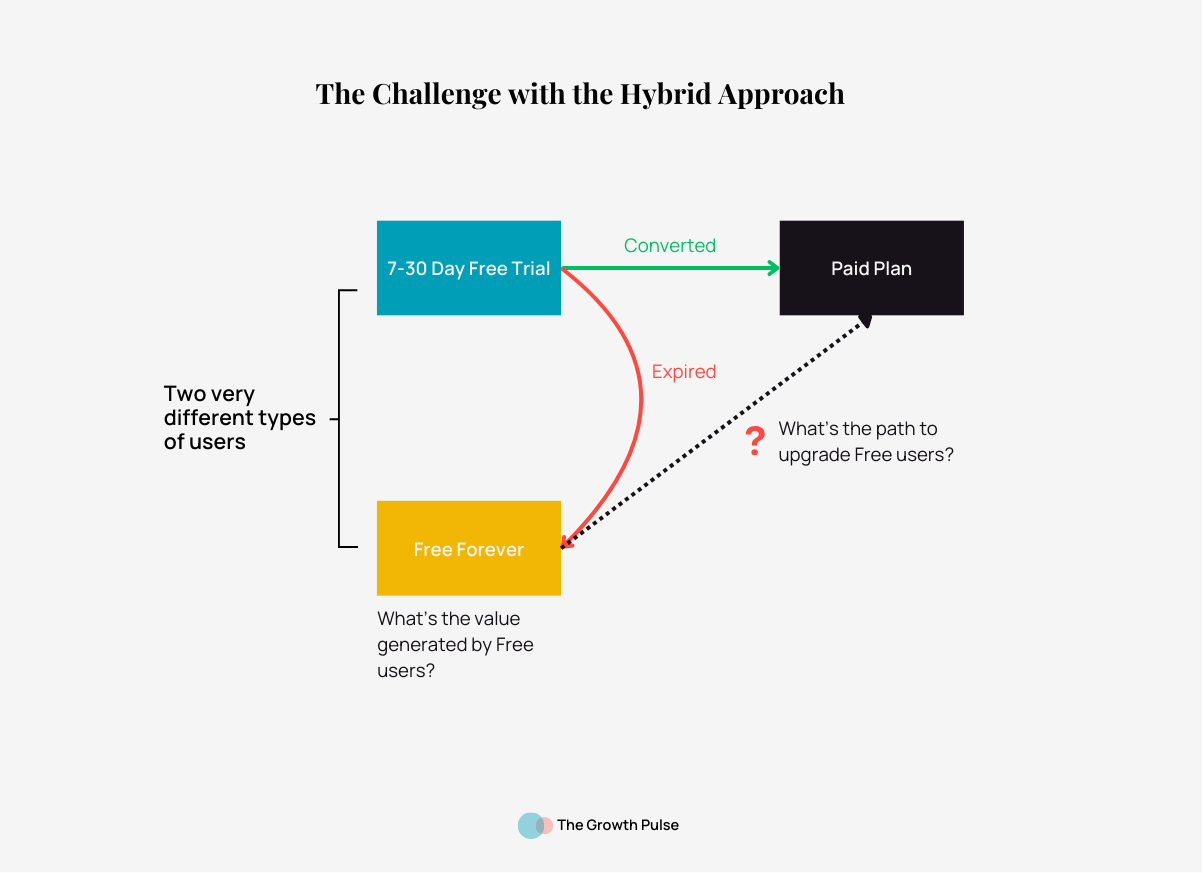
The bottom line: Free Trial users should be converted before they fall back to Freemium, and Freemium users should be continuously nudged toward upgrading. Every free user should have a clear purpose in your growth strategy.
Tldr;
The biggest mistake companies make is choosing a model without a strategy. The best approach depends on your pricing, onboarding complexity, market size, and GTM motion.
If your product requires onboarding and delivers fast value, go with free trials.
If your market is broad and your product is easy to adopt, freemium could be a better bet.
If you can’t decide, experiment with a hybrid model and optimize based on conversion data.
Choosing the right model isn’t just about acquisition—it’s about setting the right expectations for retention and monetization. Be strategic, test continuously, and build a path that leads to sustainable growth.
What’s your experience with free trials vs. freemium? Let’s discuss in the comments!